
A good darts throw is simple: stand still, hold the dart lightly, swing your forearm from a steady elbow and let go smoothly. Nearly every problem comes from adding movement that doesn’t need to be there. This guide walks through each part, and each one has its own page if you want more detail.
The short version
- Set up properly. Bull center 5 ft 8 in (173 cm) from the floor; steel tip throw line 7 ft 9¼ in (237 cm) horizontally from the board face. See dart board height and distance.
- Stand side-on or at about 45° with your throwing-side foot forward at the line and most of your weight on it.
- Hold the dart lightly near its balance point, point tilted slightly up.
- Aim with your eye, the dart and the target in one straight line.
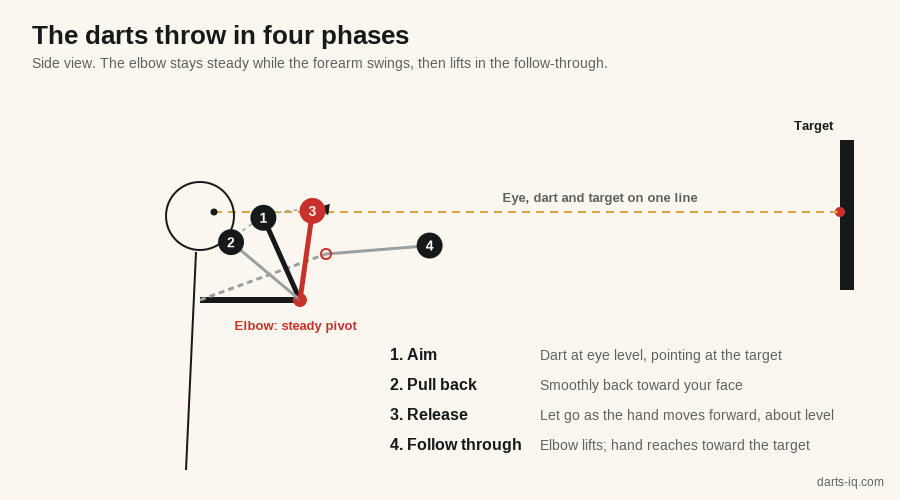
- Throw from the elbow: pull back toward your face, accelerate forward, release, and follow through toward the target.
1. Get the setup right first
Practicing at the wrong height or distance builds a throw that falls apart on a regulation board. Check your board before you work on anything else: the center of the bull goes 5 ft 8 in (173 cm) from the floor and the throw line goes 7 ft 9¼ in (237 cm) from the board face for steel tip, or 8 ft (244 cm) for most US soft tip leagues. Our height and distance guide has every number and how to measure, and the throw line guide shows how to mark the oche.
2. Stance: a still, balanced base
Your stance has one job: keep your body still while your arm moves. Put your throwing-side foot forward (right foot for right-handers), toes just behind the line, with most of your weight on it. Your back foot is there for balance.
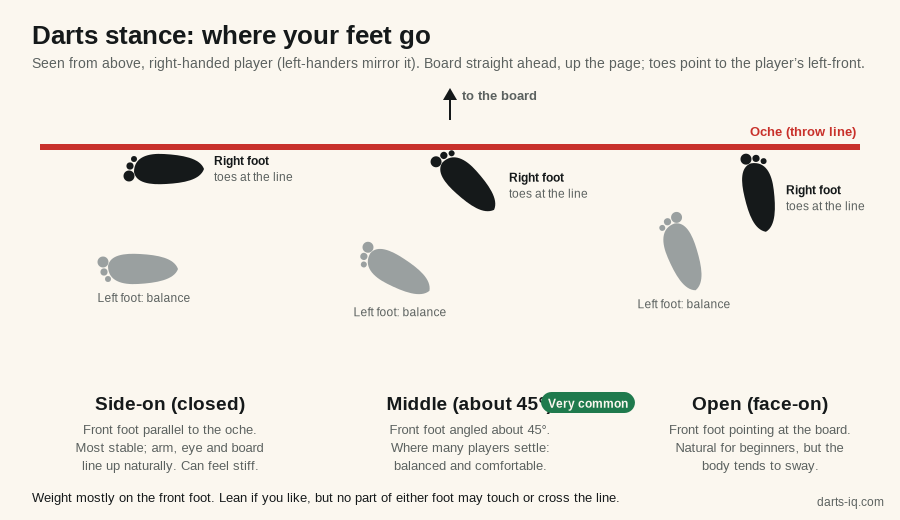
- Side-on lines up your eye, arm and board most naturally but can feel stiff.
- About 45° is where many players end up: stable and comfortable.
- Open (face-on) feels natural to beginners, but the body tends to sway.
Lean forward if you like, but don’t lean so far that you wobble, and keep both feet behind the line. More on foot position, leaning and where to stand along the line in our darts stance guide.
3. Grip: lighter than you think
Find the dart’s balance point by resting the barrel across one finger. Put your thumb just behind that point and your fingers on top. Most players use three fingers (thumb, index, middle), but two, four and five-finger grips all work.
Two rules matter more than the number of fingers:
- Don’t squeeze. Your fingertips should go no whiter than normal. A tight grip makes the release jerky.
- Point slightly up. The point should tilt up a little as you aim, not down.
Our guide to how to hold a dart covers each grip, which suits which barrel shape, and the common mistakes.
4. Aim: eye, dart, target
Bring the dart up to eye level so that, looking with your dominant eye, the dart sits on the line to your target. Aim at a spot (the middle of the triple 20, not “the top of the board”) and keep your head still through the throw. Our aiming guide explains how to find your dominant eye and how to fix darts that drift left or right.
5. The throw: pull back, release, follow through
Pull back. Bring the dart smoothly back toward your face, pivoting at the elbow. How far is personal: some players pull back to the cheek, others only a few inches. What matters is doing it the same way every time. Don’t pause long at the back.
Accelerate and release. Swing the forearm forward and let the dart go as your arm speeds up and starts to straighten. Release too early and the dart goes high; too late and it goes low. You don’t need power: smooth speed sends the dart in a gentle arc into the board.
Follow through. Keep the arm moving after the dart has left, finishing with your hand extended toward the target. Your elbow can rise slightly at the very end. Cutting the follow-through short is one of the most common reasons darts land low.
Don’t spin it. Darts don’t need spin. A little natural rotation is fine, but twisting the dart on purpose only adds error.
Common mistakes and quick fixes
| Mistake | What happens | Fix |
|---|---|---|
| Moving the elbow sideways | Darts spread left and right | Keep the elbow on one line; let it rise, not swing |
| Gripping too hard | Jerky release, darts wobble | Relax until the dart only just stays in control |
| Throwing too hard | Tense arm, no consistency | Slow down; aim for smooth speed, not power |
| Stopping the follow-through | Darts drop low | Finish with your hand reaching toward the target |
| Body swaying or lunging | Random misses in every direction | Weight forward, back foot planted, only the arm moves |
| Changing something every throw | Nothing becomes repeatable | Change one thing at a time and give it a session |
Still missing in the same place? Fix your darts throw matches each kind of miss (low, high, left, right, wobbling or falling out) to its usual cause.
Read your grouping
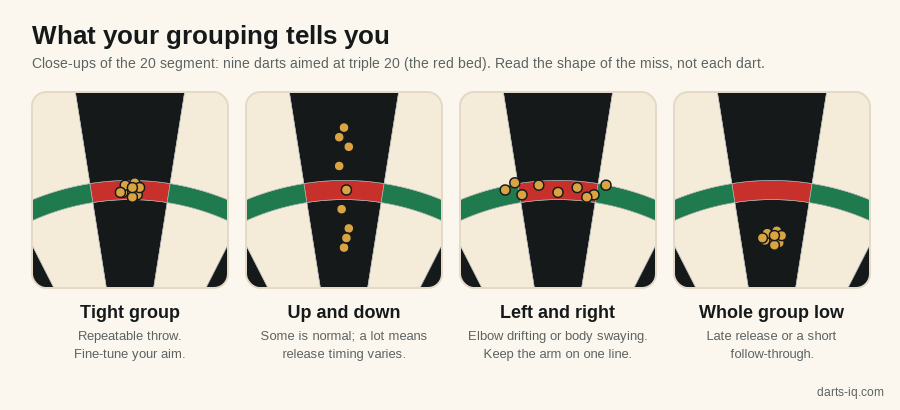
Throw nine darts at triple 20 and look at where they land as a group. The shape of the miss offers clues about what to investigate.
Practice the throw, not just the game
Playing games is fun, but you improve fastest with short, focused sessions: grouping drills, doubles and scoring routines. Our darts practice routine gives you a 30-minute session and the classic drills, and how to get better at darts collects the habits that make the biggest difference. Track your 3-dart average or PPD so you know whether a change is working.
If your release starts to lock up, with the dart sticking in your hand at the moment you should let go, read our guide to dartitis.
Throwing rules worth knowing
- Throw from behind the line. Do not step on or across a raised steel tip oche. NDA soft tip rules allow stepping on the marked line, but not across it. You can lean over it; follow your league’s rules.
- Three darts per turn. Each dart must be thrown deliberately, by hand, one at a time.
- Bounce-outs score nothing in steel tip, and you can’t throw them again. Soft tip boards usually count a dart that registers even if it falls out.
New to the game itself? Start with how to play darts, then learn 501 and cricket.
FAQ
What are the fundamentals of throwing darts?
Five things: a stable stance with your throwing-side foot forward, a relaxed grip near the dart's balance point, aiming with your eye, dart and target in line, a smooth throw that pivots at the elbow, and a full follow-through toward the target.
Do heavier darts fly straighter?
Not necessarily. Weight alone does not determine how straight a dart flies. Its design and your release also matter. Try several weights and choose the one you can throw comfortably and consistently.
Should you spin a dart when you throw it?
No. Don't add spin on purpose. A little natural rotation from your fingers is normal and harmless, but twisting the dart at release adds sideways error. Focus on a straight release instead.
How hard should you throw a dart?
Only hard enough to fly in a gentle arc and stick firmly. Throwing hard tightens your arm and spoils your accuracy. Smooth speed from a relaxed arm is what you want.
Is it illegal to throw darts underhand?
Standard rules don't ban any throwing style; they only require the dart to be thrown by hand from behind the oche. Underhand throwing is legal, but it's very hard to repeat accurately, so almost no competitive players use it.
How far do you stand from a dart board?
7 ft 9¼ in (237 cm) from the board face for steel tip, and 8 ft (244 cm) for most US soft tip leagues. Keep your toes behind the line as a beginner. Do not step on a raised steel tip oche; NDA soft tip rules allow stepping on the marked line, but not across it. Follow your league's rules.
Do you throw with your wrist or your arm?
Mostly your forearm, swinging from a steady elbow. The wrist adds a little snap at the release, but a big wrist flick is hard to repeat. Keep the upper arm steady and let the forearm do the work.