
Part of our guide to Dart board height and throw distance: the exact numbers.
The numbers: steel tip uses 7 ft 9¼ in (237 cm) from the board face to a raised oche’s player-facing back surface or, under ADO rules, a flush line’s board-facing front edge. Most US soft tip leagues use 8 ft (244 cm); check their marking rules. The steel tip diagonal from bull to that floor boundary is 9 ft 7⅜ in (293 cm). The full setup is in dart board height and throw distance.
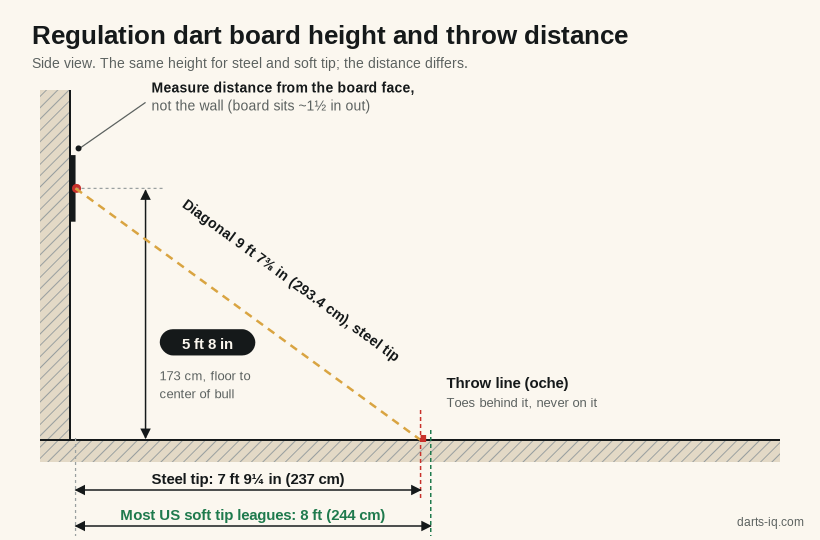
Measure from the wall (the easy way)
You’ll mark the floor from the wall, so add the board’s depth first:
| Board | Face off the wall | Steel tip line from the wall | Soft tip (8 ft (244 cm)) line from the wall |
|---|---|---|---|
| Bristle board, standard bracket | about 1½ in (4 cm) | about 7 ft 10¾ in (241 cm) | about 8 ft 1½ in (248 cm) |
| Bristle board in a cabinet | about 2–3 in (5–8 cm) | about 7 ft 11¼–8 ft ¼ in (242–244 cm) | about 8 ft 2–3 in (249–251 cm) |
| Electronic board | about 2–4 in (5–10 cm) | about 7 ft 11¼ in–8 ft 1¼ in (242–247 cm) | about 8 ft 2–4 in (249–254 cm) |
Measure your own board: hold a straightedge across its face and measure back to the wall. Or enter the depth in the height and distance calculator.
Step by step
- Drop a center line. Hang a plumb line (or use a laser level) from the center of the bull to the floor and mark the spot under the board.
- Measure straight out from that spot along the floor to your distance. Keep the tape level and square to the wall.
- Mark the boundary: the raised oche’s player-facing back surface or, under ADO rules, the flush marking’s board-facing front edge. Keep it parallel to the wall.
- Check the diagonal from the bull to that floor boundary: 9 ft 7⅜ in (293 cm) for steel tip. If it’s off, fix the height or the distance.
Ways to mark it
- Throw line sticker or strip: cheap and clean on hard floors. Some are metal or raised so you can feel the line with your toe.
- Tape: fine for testing; it wears and creeps. Swap for something permanent once you’re happy.
- Dart mat: often has steel and soft tip lines. Follow the manufacturer’s positioning instructions, then independently verify the board-face distance to the applicable throw-line edge.
- Raised oche: a low toe-stop strip like the ones on TV. You stand behind it, not on it, so it doesn’t change the bull height.
Dart mats: worth it?
A mat earns its place if you have a hard or nice floor: dropped darts blunt their points on concrete and dent wood. It also stops the line from moving. Things to check:
- Length: at least 9 ft 6 in (290 cm), so you have room to stand behind the line.
- Both lines printed if you play steel and soft tip.
- Thickness: a thin mat makes no real difference to height. For concrete and tile, foam under the mat protects better: see floor protection. If it’s thick enough to raise you noticeably, measure the bull height from the top of the mat, the surface you throw from.
See dart mats and throw lines with current US prices.
How much floor you need
About 10 ft (305 cm) from the wall for steel tip (about 10 ft 4 in (315 cm) for an 8 ft (244 cm) soft tip line): the line plus 2 ft (61 cm) to stand and step back. Give 3 ft (91 cm) either side of the board’s center so people waiting stand out of the way. Deciding where it goes? See where to put a dart board. The full set of numbers, including oche width, is in dart board measurements.
Throw line rules
Under ADO rules, don’t stand on a raised oche or extend a foot past its player-facing back surface. With a flush marking, you may stand on it, but not past its board-facing front edge. You can lean over the boundary and stand anywhere along it. Stepping over to pull your darts is fine once all three are thrown. Line marked? Start with 301 (double in, double out), the quickest full game to learn.
FAQ
How far is the throw line from a dart board?
7 ft 9¼ in (237 cm) from the board face for steel tip: to a raised oche's player-facing back surface or, under ADO rules, a flush line's board-facing front edge. Most US soft tip leagues use 8 ft (244 cm); follow your league's marking rules.
Why is it called the oche?
Oche (rhymes with 'hockey') is the traditional name for the throw line. Nobody agrees on where the word came from; stories about breweries and old words for 'notch' are popular but unproven.
Can you step on the throw line?
Under ADO rules, you cannot stand on a raised oche or extend a foot past its player-facing back surface. You may stand on a flush marking, but not past its board-facing front edge. You can lean over the boundary.
How wide is a standard oche?
Rule bodies differ: the WDF specifies a 2 ft (610 mm) oche and some national bodies use 3 ft (914 mm). At home, 2 ft (610 mm) is typical. Leave clear floor either side of it.
Are dart mats worth it?
Yes, if you have a hard floor or want a reusable throw line. A mat protects the floor from dropped darts. Follow its positioning instructions, then verify the distance from the board face to the applicable throw-line edge.
Can beginners or kids stand closer to the board?
At home, yes. There's no rule against a shorter practice line while someone learns; many families mark a second line a couple of feet in front of the real one. Use the regulation distance for any game that counts.
Do you measure the throw line from the wall or the board?
From the face of the board. The board sticks out from the wall (more in a cabinet), so a line measured from the wall ends up too close. Drop a plumb line from the bull, mark the floor under the board face, and measure from there.
Where do you measure the throw line to?
For a raised oche, to its player-facing back surface. Under ADO rules, for tape or another flush marking, to its board-facing front edge. Measure horizontally from the board face.