
Part of our guide to How to throw darts: a step-by-step guide.
Your stance is the base everything else sits on. If your body moves, your dart moves. A good stance keeps you still and balanced while your arm swings, and lines your eye, arm and target up without twisting. Everything else in the throw builds on it.
Throwing-side foot forward
Right-handers put the right foot forward; left-handers, the left. The front foot goes right behind the throw line and takes most of your weight, and many coaches suggest around 70 to 80%. The back foot sits behind and to the side, mainly for balance.
Pick your angle
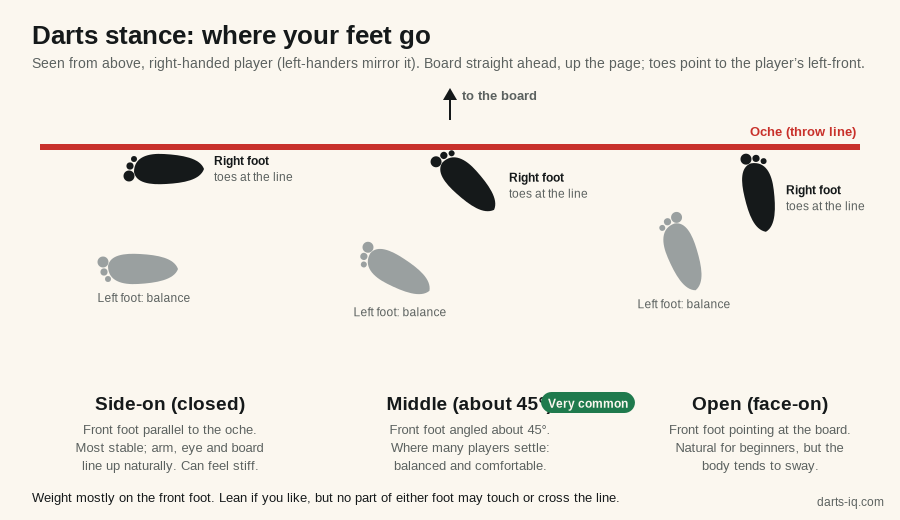
| Stance | Front foot | Good | Watch out for |
|---|---|---|---|
| Side-on (closed) | Parallel to the oche | Eye, arm and board line up naturally; very stable | Can feel stiff and strain the back |
| Middle | About 45° to the oche | Balanced and comfortable; where many players end up | Nothing in particular, which is why it’s popular |
| Open (face-on) | Pointing at the board | Feels natural at first | Body tends to sway and twist |
Try all three. Throw a few rounds at triple 20 from each and keep the one where your body stays stillest and your arm swings straight at the target without reaching across you.
Where along the line to stand
Start with your front foot in the middle of the oche, then shuffle left or right until your throwing arm points at the target without twisting your shoulders. Where you end up depends on your build and stance. Some players move along the line during a game, for example to get a better angle on triple 19 or to see past a dart blocking triple 20.
Leaning and balance
Leaning forward shortens the distance a little and is allowed, but every bit of lean is something you have to hold still. Lean only as far as you can stay perfectly steady through the throw and follow-through. If you feel yourself tipping after the dart leaves, you’re leaning too far.
Keep your knees soft, not locked, and your shoulders level. Your head stays still from aim to follow-through.
Find your dominant eye
Aiming is easier when your stance puts your dominant eye over the line of the throw. To find it: hold your thumb up at arm’s length over a distant object, then close each eye in turn. The eye that keeps your thumb on the object is your dominant eye. Most people’s matches their throwing hand, though many don’t. If yours doesn’t, an open or middle stance usually helps bring that eye into line. More in our aiming guide.
Foot faults: what the rules say
- Behind the line. Under DRA steel-tip rules, keep your front foot grounded behind the player-side toe edge and do not tread on the raised oche; a violating dart does not score. NDA soft-tip rules allow stepping on the flat line, but not across it.
- Leaning is fine. Your body, arm and head can all be over the line.
- Standing to the side is fine. Under DRA rules, stay behind the referee-adjudged extension of the player-side toe edge, with your front foot grounded. For NDA soft tip, you may step on the flat line, but not across it.
The line itself is 7 ft 9¼ in (237 cm) from the board face for steel tip and 8 ft (244 cm) for most US soft tip leagues. See our throw line guide for marking one at home and the height and distance guide for every measurement.
Stance mistakes to avoid
- Lunging forward as you throw. Your body should finish where it started.
- Lifting or shuffling the front foot between darts. Plant it and leave it.
- Twisting the shoulders to reach the target. Move your feet instead.
- Copying a pro’s stance exactly. Their build isn’t yours. Use the principles: still, balanced, lined up.
Once your stance feels settled, move on to how to hold a dart.
FAQ
Which foot goes forward in darts?
Your throwing-side foot: right foot forward if you throw right-handed, left foot if you throw left-handed. It goes at the throw line with most of your weight on it.
How should I position my feet when throwing darts?
Front foot at the line, angled anywhere from parallel to the oche (side-on) to about 45°. The back foot sits behind for balance. Many players settle around 45°.
Can you lean over the oche in darts?
Yes. Under DRA steel-tip rules, keep your front foot grounded behind the player-side toe edge and do not tread on the raised oche. NDA soft-tip rules allow stepping on the flat line, but not across it. Lean only as far as you can stay perfectly still.
Can you stand to the side of the oche?
Yes. Under DRA steel-tip rules, stay behind the referee-adjudged extension of the oche's player-side toe edge, with your front foot grounded. NDA soft-tip rules allow stepping on the flat line, but not across it. Players may move sideways to see past a blocking dart.
Should your back foot be on the ground?
Mostly, yes. It's there for balance. Many players let the back heel lift and keep only the toes down, which is fine. What matters is that your body doesn't move during the throw.
How far do you stand from the dart board?
The throw line is 7 ft 9¼ in (237 cm) from the board face for steel tip and 8 ft (244 cm) for most US soft tip leagues.