
Part of our guide to How to throw darts: a step-by-step guide.
Aiming in darts isn’t about squinting harder. It’s about putting your eye, the dart and the target on one line and then throwing along it without anything moving off that line. This page covers how to aim, and what to fix when the darts don’t go where you’re looking. It builds on the stance and grip from the main throwing guide.
Find your dominant eye
One of your eyes does most of the aiming. To find which: hold a thumb up at arm’s length over a distant object with both eyes open, then close one eye and then the other. The eye that keeps your thumb on the object is your dominant eye.
Most people’s dominant eye matches their throwing hand, though many don’t. If yours doesn’t, you can still aim well: an open or middle stance brings the dominant eye closer to the line of your arm, or you can bring the dart up slightly toward that eye.
Line it up
- Raise the dart to eye level in your normal grip, point tilted slightly up.
- Sight the line. Looking with your dominant eye, the dart should sit on the line between you and the target.
- Pick a small spot. Pick a precise spot, such as the center of triple 20, to give yourself a consistent aiming reference.
- Keep your head still. From aiming through to follow-through, your head doesn’t move.
- Throw along the line. Your forearm swings straight at the target and your hand finishes pointing at it.
Use the dart to line up, then let your focus settle on the target as you throw. Whatever you do, do it the same way every time.
Read the miss
Throw nine darts at triple 20 and look at the group as a whole, not at single darts.
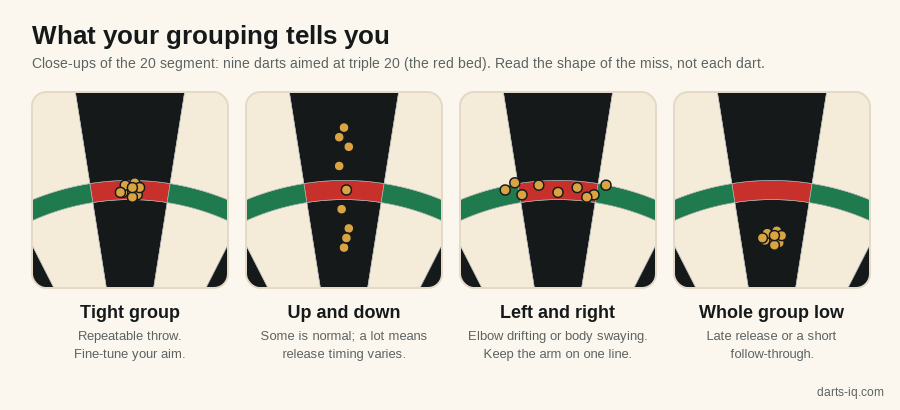
| Pattern | Usual cause | Fix |
|---|---|---|
| Tight group | Your throw is repeatable | If the group is off target, adjust where you aim, not how you throw |
| Spread up and down | Some is normal; a spread much bigger than your side-to-side spread means release timing or speed changes | Slow down and keep a steady rhythm |
| Spread left and right | Elbow drifting, wrist turning, or body swaying | Keep the elbow on one line; plant your feet |
| Whole group low | Releasing late, short follow-through, point angled down | Let go a little earlier and follow through toward the target |
| Whole group high | Releasing early or throwing too hard | Let the arm come through before you release |
Darts wobbling in the air or falling out of the board? That’s usually grip or equipment, not aim: see fix your darts throw.
How to throw straight
Possible sources of left-right misses include:
- The elbow drifts. It should rise during the throw, not swing out or across your body.
- The wrist turns. Release with the hand moving straight forward, not rolling in or out.
- The body sways. If your shoulders or hips move, so does the dart. Weight forward, feet planted.
- You twist to reach the target. If you have to turn your shoulders to line up, move your feet along the oche instead.
A simple drill: throw at the 20 segment and score only left-right error. Any dart in the 20, at any height, is a hit; darts in the 5 or the 1 are misses to that side. It isolates side-to-side movement from everything else.
Aiming when the target is blocked
If your first dart sits in front of triple 20, you have three choices: aim at a part of the triple the dart isn’t covering, move along the oche to get a different angle, or switch targets. Many right-handers switch to triple 19, the next-highest triple, at the bottom left of the board. Players who change targets often learn the 19s and 18s as well as the 20s.
Keep working on it
Aim improves through repetition. Our darts practice routine has grouping and doubles drills, and how to get better at darts covers the habits that turn practice into lower misses.
FAQ
What part of the dart do you aim with?
Use the dart to line up: from your dominant eye, sight along the barrel and point so the dart sits on the line to the target. Then, as you throw, let your focus settle on the target itself.
How do I aim when throwing a dart?
Bring the dart up to eye level so your dominant eye, the dart and the target sit on one line. Focus on a small spot, like the middle of the triple 20, keep your head still and throw along that line.
Is there a trick to throwing darts straight?
Keep your elbow on one line. Left-right misses can come from the elbow drifting out or across the body, or from the body swaying. Keeping the elbow and forearm aligned can help reduce sideways variation, but a consistent release matters too.
Why do my darts always go to the left?
For a right-hander, darts that pull left usually mean the elbow is drifting across the body or the wrist is turning in at release. Darts going right usually mean the elbow is flaring out. Check your stance too: twisting to reach the target causes both.
Why do my darts go low?
The usual causes are releasing late, cutting the follow-through short, or the point angled down in your grip. Let go a fraction earlier and finish with your hand reaching toward the target.
Why do players switch to triple 19?
Mostly because darts already in triple 20 block the bed. Triple 19 is the next-highest triple (57), so switching keeps the scoring high; some players also switch to reset when their grouping drifts.
Is any number on a dart board harder to hit?
Every segment is the same size, so no number is harder in itself. What feels harder comes from your throwing angle and darts already in the board. The smallest targets are the bull and the triple ring.
Should you look at the dart or the target?
The target. Use the dart to line up, but your focus should be on the exact spot you want to hit as you throw.