
Part of our guide to How to throw darts: a step-by-step guide.
Your grip is the part of the throw that touches the dart, so small changes here show up on the board. There’s no single correct grip: professionals hold their darts in very different ways. The goal is a grip that controls the dart without tension and that you can repeat every time. Get your stance settled first; the grip comes next in the throw.
Start with the balance point
Rest the barrel across your index finger and slide it until the dart balances. That’s its center of gravity. As a starting exercise, put your thumb just behind that point, on the underside of the barrel. Your fingers go on top.
Hold the dart well in front of its balance point and the tail drops, so the point rises. Hold it well behind and the point tips down. Just behind is a starting point, not a requirement. Front weighting shifts the balance point forward, but test a comfortable grip rather than automatically moving it forward.
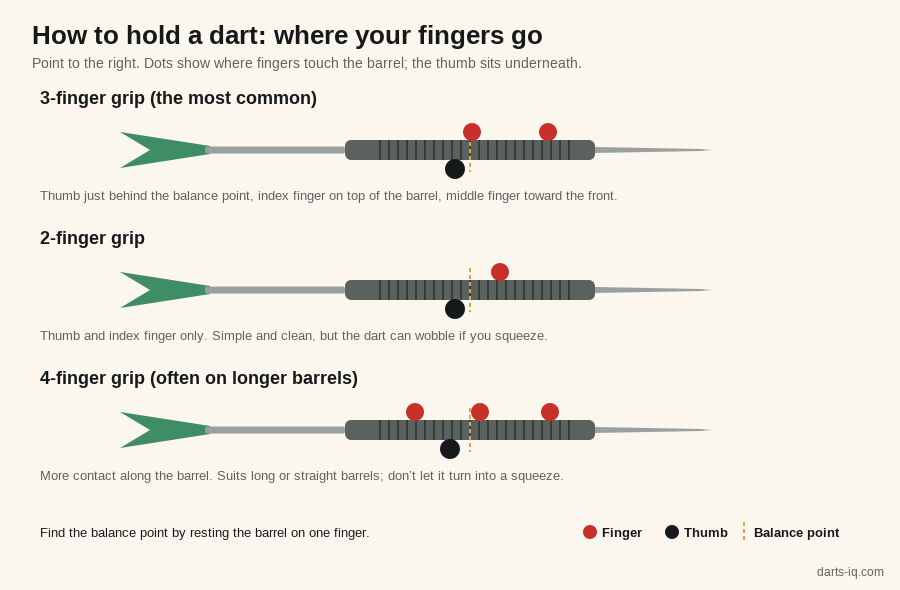
The main grips
| Grip | How it works | Suits |
|---|---|---|
| 3-finger | Thumb under, index finger on top, middle finger toward the front of the barrel | Most players; the best place to start |
| 2-finger | Thumb and index finger only | Short barrels and players who like a simple, clean release |
| 4-finger | Thumb plus three fingers spread along the barrel | Long or straight barrels; more contact along the barrel |
| 5-finger | Every finger touches the dart | Rare; very long barrels. Easy to over-grip |
| Pencil grip | Held near the front like a pen, fingers close together | Front-grip players with front-loaded or torpedo barrels |
Start with three fingers. If it feels crowded, drop to two; if the dart feels loose, add a finger.
Five rules for any grip
- Light pressure. Hold the dart just firmly enough that it won’t slip. If your fingertips whiten, you’re squeezing.
- Point up slightly. As you aim, the point should tilt a little upward. A point aiming at the floor drops the dart low.
- Keep clear of the flight. Comfortable shaft contact can work in a repeatable rear grip; avoid any contact that catches during release.
- Fingers apart, not stacked. Fingers jammed together tend to drag on the dart as it leaves your hand.
- The same every time. Pick the dart up and set your grip the same way before every throw. Some players roll the barrel in their fingers until it sits right.
Match the grip to the barrel
Where your fingers go depends on shape, balance and comfort:
- Straight barrels often offer several finger positions, but balance depends on the model and assembled setup. Find the dart’s balance point first.
- Front weighting shifts the balance point forward; torpedo shape doesn’t guarantee it. Test a comfortable grip rather than automatically gripping nearer the front.
- Long barrels leave room for a 4-finger grip; short, slim barrels suit 2 or 3 fingers.
The surface matters too. Grip strength varies with cut depth, spacing and the particular barrel, not just names like knurled or ringed. Aggressive cuts can help sweaty hands but catch on release; smooth barrels suit players who barely touch the dart. Choosing a new set? See how to choose darts.
The dart finder filters every dart by barrel shape and grip, so you can find a barrel that suits how you hold it.
Common grip mistakes
| Problem | Likely cause | Fix |
|---|---|---|
| Dart wobbles in flight | Squeezing, or a finger dragging on release | Relax the grip; check no fingers catch during release |
| Darts drop low | Point angled down, or thumb well behind the balance point | Tilt the point up; move your thumb forward slightly |
| Dart sticks to your fingers | Grip too firm or too much contact | Drop a finger or ease the pressure |
| Every dart feels different | Grip changes each time | Set the grip with the same routine before every dart |
Next steps
Once the grip feels natural, work on your stance and how to aim. Give any grip change at least a few sessions before judging it: anything new feels worse at first.
Your grip and barrel shape go together: our guide to dart barrel shapes explains which shapes suit front, middle and rear grips.
FAQ
Should you grip darts with two or three fingers?
Either works. Three fingers (thumb, index and middle) is the most common because it gives control without crowding the dart. Two fingers is simpler; four suits longer barrels. Pick the one you can repeat without squeezing.
Where should you hold a dart?
Start on the barrel, with your thumb just behind the balance point. Find that point by resting the barrel across one finger until it balances. Front weighting shifts it forward, but test a comfortable grip rather than automatically moving yours forward.
How tight should you hold a dart?
Just tight enough to control it. If your fingertips go white or your forearm tenses, you're squeezing. A tight grip makes the release jerky and the dart wobble in the air.
Should your fingers touch the point or shaft?
Keep your fingers clear of the flight and avoid contact that catches during release. Comfortable shaft contact can work in a repeatable rear grip. Some players rest a fingertip on the very front of the barrel or the start of the point, which is fine as long as it's the same every time.
Do pros all hold the dart the same way?
No. Professional grips vary a lot, from two-finger to five-finger and from the back of the barrel to the very front. What they share is a grip they repeat exactly, dart after dart.
Which barrel grip is best?
It depends on your hands. Grip strength varies with cut depth, spacing and the particular barrel, not just the pattern name. Aggressive cuts can help sweaty hands but may snag a release; smooth barrels suit very light grips. Try a few before you buy.