
Part of our guide to How to throw darts: a step-by-step guide.
The fastest way to improve at darts isn’t throwing more darts. It’s throwing them with a purpose. Short sessions with clear targets and a score you can track beat hours of aimless throwing. Here’s a 30-minute routine and the drills that go in it. Build it on the throw described in our guide to how to throw darts.
A 30-minute session
| Time | Drill | What it builds |
|---|---|---|
| 5 min | Warm-up grouping: 9 darts at the 20, then 9 at the bull, then 9 at a number you like | Rhythm and a consistent release |
| 10 min | Scoring: 10 visits (turns of three darts) at triple 20, record each score | Your scoring power and your average |
| 10 min | Doubles around the board: double 1 to double 20, then bull | Accuracy on doubles before adding pressure |
| 5 min | Pressure doubles or checkout game: Bob’s 27 or 121 | Pressure doubles or checkout practice |
The clock overrides completion: stop doubles after ten minutes and record the last target reached. Stop the final game after five minutes too; if Bob’s 27 is unfinished, label it a partial attempt and keep its result separate from completed-game scores.
Keep a notebook or use an app and write the numbers down. Camera scoring systems can track your averages automatically. The scoring block gives you a 3-dart average to watch over weeks; see our guide to darts stats for what the numbers mean and what counts as good.
The warm-up: grouping
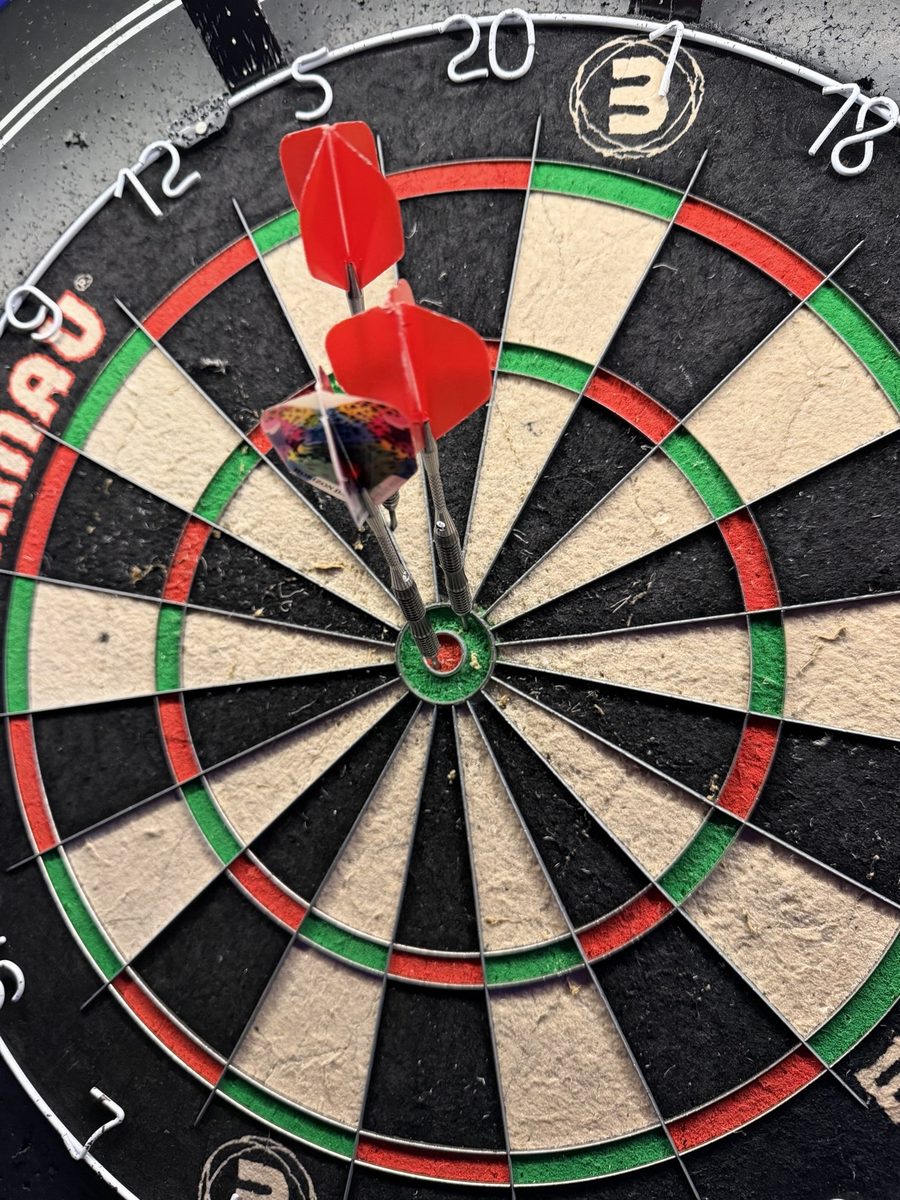
Throw three darts at one target, retrieve, repeat. Don’t chase the board: if your first dart lands off target, still aim at the original spot. You’re warming up a repeatable throw, not trying to score. Our aiming guide shows how to read the shape of each group.
Scoring drills
- Triple 20 visits. Ten visits at the triple 20, scoring each. Track the total each session.
- Count-up. Score as much as you can in a set number of rounds. Our count-up rules give the standard version.
- Switch to 19s. Five visits at triple 20, then five at triple 19. Being able to switch matters when 20 is blocked.
- Three in a bed. Count only visits where all three darts land in the same bed (usually a triple).
Doubles drills
Doubles win games. Many players practice scoring far more than finishing, which is backwards.
- Around the clock on doubles. Hit double 1, then double 2, all the way to 20 and the bull. Count the darts it takes. Our around the clock guide covers the standard game and variations.
- Favorite doubles. Thirty darts at double 16 and double 20, counting hits. These are the doubles you’ll leave most often.
- Halve-it. A game that forces you to hit set targets each round or lose half your score. See halve-it.
Bob’s 27
A classic doubles drill named after Bob Anderson, the 1988 world champion.
- Start with 27 points.
- Throw three darts at double 1. Each hit adds 2 points (the double’s value).
- If all three miss, subtract the double’s value instead.
- Move on to double 2, then double 3, and so on to double 20, then the bull (each hit adds 50).
- If your score drops to zero or below, the game is over (some versions end only below zero).
Each double adds twice its number per hit, so later doubles are worth more and missing them hurts more. A perfect game (every dart hits) scores 1,437. Finishing all 21 rounds at all is a good start; beating your own best is the goal.
121
A finishing drill that builds checkout skill:
- You have nine darts (three visits) to check out 121, finishing on a double as in 501.
- If you finish, your next target is 122.
- If you don’t, try the same number again (some players drop back one instead).
See how high you can climb in a session. Not sure of the route? Our checkout calculator gives the standard out for every score.
Learning your checkouts
Knowing your outs saves you from thinking at the oche, and thinking is where finishes go wrong. Don’t try to memorize a whole chart at once:
- Start with the two-dart finishes up to 100 (a triple or single, then a double). Most of them follow a pattern: score down to 40, 32 or 16.
- Then the three-dart finishes from 101 to 170. Learn your preferred route for each, plus a back-up for when the first dart misses.
- Know the bogey numbers (159, 162, 163, 165, 166, 168 and 169 can’t be finished in three darts), so you don’t leave them. See darts numbers and facts.
- Practice them on the board. Play 121, or pick random finishes between 61 and 100 and give yourself six darts each.
Leave yourself friendly doubles. Double 16 is the favorite: a miss into the single 16 leaves double 8, then double 4, so you keep a finish. Double 20 and double 8 work the same way. Odd numbers and doubles like double 3 split badly.
When to switch off the 20s. Near a finish, the biggest score isn’t always the best one. On 62, triple 20 leaves double 1; triple 10 leaves 32, the friendliest double on the board. Aim for what you’ll leave, not what you’ll score. A checkout calculator shows the standard routes, but work each one out yourself first: that’s what makes it stick.
Make practice count
- Practice on a correct setup. Board height and throw line must be right, or your practice won’t carry over. See dart board height and distance.
- One thing at a time. If you’re changing your grip, keep everything else the same for a few sessions.
- Stop when you’re tired. Tired practice teaches a tired throw.
- Play matches too. Drills build the throw; games teach you to use it under pressure. No one to play? Play darts online against real opponents.
More habits that help are in how to get better at darts.
FAQ
What is the best practice routine for darts?
Short and focused: a few minutes of grouping on the 20s or the bull, then scoring practice, then doubles and a pressure doubles game like Bob's 27 or a checkout game like 121. Keep score so you can see whether you're improving.
How long should you practice darts each day?
20 to 45 minutes of focused practice is plenty for most players. Several short sessions a week beat one long one, and practice with a goal beats throwing without one.
How many hours of practice does it take to get good at darts?
There is no fixed timeline or universal league-level average. Track your scoring average and doubles hit rate over time to measure your own improvement.
What is Bob's 27 in darts?
A doubles practice game created by 1988 world champion Bob Anderson. You start on 27 points and throw three darts at each double from 1 to 20, then the bull. Hits add the double's value; three misses subtract it. Drop to zero or below and the game ends.
What is the 121 darts game?
A checkout drill. You get nine darts to finish 121, ending on a double. If you do it, your next target is 122; if you don't, you try that number again. It builds the finishing skills that win 501 legs.
How long does it take to hit your first 180?
There is no fixed timeline for your first 180. It requires all three darts in triple 20; focus on repeatable grouping rather than a deadline.
What is the best way to learn darts checkouts?
Learn them in groups rather than all at once: the two-dart finishes up to 100 (all except 99) first, then 101 to 170. Practice them on the board with a checkout game like 121, and work out the route yourself before checking a chart.
Which doubles are best to leave in 501?
Double 16 (32) is the favorite, because a miss into the single 16 leaves double 8, then double 4. Double 20 (40) and double 8 (16) are also good. Odd doubles like double 3 halve badly.
What is a good doubles practice routine?
Around the clock on doubles to cover the whole board, then 30 darts each at your two favorite doubles counting hits, then Bob's 27 for pressure. Track your hit rate per double.
Should you practice on your own or with someone?
Both. Solo drills build the throw; playing better players teaches you to handle pressure. A league is the easiest way to get regular matches.