
Part of our guide to 40+ dart games to play on a dart board.
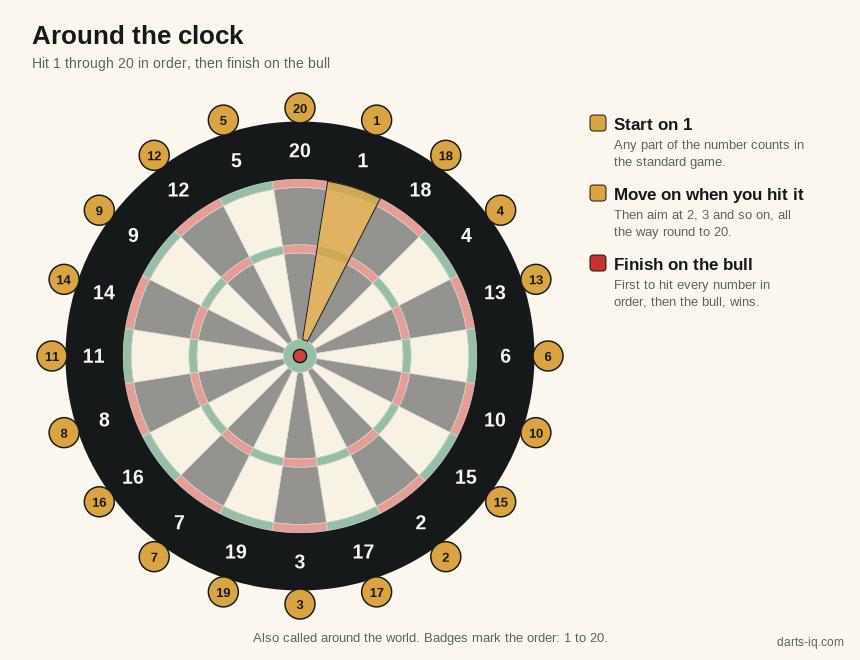
Around the clock in one line: hit 1, then 2, then 3, all the way to 20, and finish on the bull. The first player through the whole board wins. There’s no scoring and no math, so it’s a great first game and a classic practice drill. It’s a nice change from scoring games like cricket and 501, and one of many more dart games you can play on any board.
Around the clock vs. around the world
They’re the same game. “Around the clock” is the usual name, because you work around the board like the hands of a clock. “Around the world” is the other common name, and lots of players use the two interchangeably.
When people do mean something different, it’s usually the doubles game: each number has to be hit in its double, from double 1 up to the bull. Some players and apps call that ‘doubles around the world’. If you’re playing someone new, ask which version they mean.
Around the clock at a glance
| Quick facts | |
|---|---|
| Players | 1 or more |
| Darts per turn | 3 |
| Targets | 1 to 20 in order, then the bull |
| How you win | First to hit every target in order |
| Time to play | About 10–20 minutes for two players |
How to play
- Throw for the bull to decide who goes first.
- Everyone starts on 1.
- On your turn, throw three darts at your current number.
- Hit it and move on to the next number straight away. You can hit 1, 2 and 3 in one turn.
- If you miss, keep aiming at the same number with any darts remaining in your turn. If you still haven’t hit it after three darts, resume there next turn.
- In the most common version, any part of the number counts: single, double or triple.
- After 20, go for the bull. Most groups accept the outer bull (25) or the inner bull (50).
- First player to hit the bull wins.
Scoring
There are no points. You only track which number each player needs next. Write each player’s name and the number they’re on, or cross off numbers as you go.
Example game, first three turns:
| Turn | Player A darts | A now needs | Player B darts | B now needs |
|---|---|---|---|---|
| Start | 1 | 1 | ||
| 1 | 1, 2, 18 (miss) | 3 | 20 (miss), 1, 2 | 3 |
| 2 | 3, 19 (miss), 4 | 5 | 3, 4, 5 | 6 |
| 3 | 5, 6, 7 | 8 | 11, 14, 9 (all miss) | 6 |
After three turns, Player A has hit 7 numbers in 9 darts and Player B has hit 5.
Keeping track on your phone? Our free darts scorer shows the number each player needs and counts your darts, which makes it a handy solo practice log.
How to win (and ties)
The first player to hit the final target wins. Because the player who throws first can finish a turn ahead, some groups let the other player finish the round. If they also hit the bull, it’s a tie, and you can play off with one dart each at the bull, closest wins.
Tips and strategy
- Know where the numbers are. The board order is 20, 1, 18, 4, 13, 6, 10, 15, 2, 17, 3, 19, 7, 16, 8, 11, 14, 9, 12, 5. Low numbers are spread out, so you move all over the board.
- Aim for the big single. Unless you’re playing a doubles or triples version, aim at the wide single bed between the triple and double rings.
- Reset after every hit. Take a breath before each new number. Rushing is how you miss the next one.
- Count your darts. Solo, write down how many darts it takes to finish, then try to bring that number down over the weeks.
- Practice your weak side. If 11, 14 and 8 always take you longest, spend extra time on the left of the board.
Variations
House rules vary a lot. These are the common ones.
- Skip-ahead (doubles and triples). A single moves you on one number, a double moves you on two, and a triple moves you on three. Hit triple 1 and you go straight to 4. Faster and more exciting.
- Doubles only. Every number must be hit in its double. Harder, and great checkout practice.
- Triples only. Every number must be hit in its triple. Hard work for anyone.
- Singles only. Doubles and triples don’t count; you have to hit the single bed. Some groups even send you back if you hit the wrong ring.
- Backward. Start at 20 or the bull and go down to 1.
- No bull. Finish on 20.
- Random order. Some apps and electronic boards shuffle the targets, including where the bull comes.
- Short clock. Some electronic boards let you play 1 to 5, 1 to 10 or 1 to 15 for a quicker game.
- Practice version. Play solo and give yourself three darts at each number whether you hit it or not. Score one point per hit and try to beat your total.
If you like this one, try Shanghai darts, which also works through the numbers in order, or halve-it for a target game with points. New to darts? Start with how to play darts.
Playing with young kids? Around the clock works on a suction-cup board with the standard numbered 1–20 layout. For a separate kid-friendly alternative, see pop darts.
FAQ
What is around the clock in darts?
A game where you hit every number from 1 to 20 in order, usually finishing on the bull. The first player to complete the sequence wins.
Is around the world the same as around the clock in darts?
Yes. Around the world is another name for the same game. Some players use 'around the world' for the doubles version, where you have to hit each number's double, so check which one your group means.
Do doubles and triples count in around the clock?
In the most common version, any part of the right number counts, single, double or triple. In the skip-ahead version, a double moves you on two numbers and a triple moves you on three.
Do you have to finish on the bull in around the clock?
Most people finish on the bull after 20. Some play it to 20 only. Agree on it, and on whether the outer bull is enough, before you start.
Is around the clock good darts practice?
Yes. It makes you hit every part of the board, so it's one of the most common accuracy drills. Count how many darts it takes you and try to beat it.