
Part of our guide to 40+ dart games to play on a dart board.
Gotcha in one line: count up from zero and be the first to hit exactly 301, but if your total lands exactly on an opponent’s score, gotcha: they go back to zero. It’s like 301 in reverse, with a nasty twist. If you know 01 games like 301, you’ll pick it up in a minute; it’s a nice break from cricket too. It’s a favorite on electronic boards, and one of many more dart games for groups.
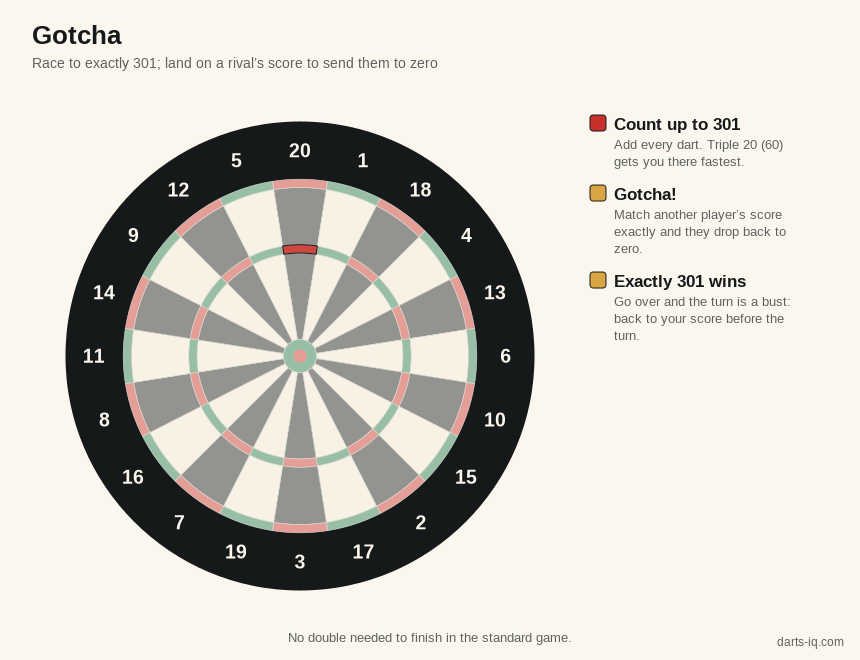
Gotcha at a glance
| Quick facts | |
|---|---|
| Players | 2 or more (best with 3 or 4) |
| Darts per turn | 3 |
| Targets | Any number; aim to land on a rival’s score or the target |
| How you win | First to reach exactly 301 |
| Time to play | About 10–20 minutes |
How to play
- Agree on the target. 301 is the most common.
- Everyone starts on 0.
- Take turns throwing three darts. Add each dart to your score.
- Singles count face value, doubles 2x, triples 3x. The inner bull is 50 and the outer bull 25 (electronic boards may score the whole bull as 50).
- Gotcha: after each dart, if your total lands exactly on another player’s score, that player goes back to 0. Your score stays where it is.
- Bust: if you go over the target, the turn is canceled and your score goes back to where it was at the start of the turn.
- The first player to hit the target exactly wins. No double is needed unless you agree on double out.
These electronic-board rules use after-each-dart checking, as on the Arachnid E520H. Follow your model’s manual; end-of-turn checking is an alternative house version.
Scoring
Keep a running total for each player. Cross it out and write 0 when someone gets caught.
For a dart-by-dart example, start on 50 with opponents on 70, 90 and 110. Three single 20s take you to 70, then 90, then 110—resetting a different opponent with each dart.
Example game to 301, two players (turn totals shown):
| Turn | Player A scores | A total | Player B scores | B total |
|---|---|---|---|---|
| 1 | 60 | 60 | 60 | 60 (gotcha: A to 0) |
| 2 | 85 | 85 | 41 | 101 |
| 3 | 100 | 185 | 84 | 185 (gotcha: A to 0) |
| 4 | 140 | 140 | 100 | 285 |
| 5 | 145 | 285 (gotcha: B to 0) | 81 | 81 |
| 6 | 20 (bust: needed 16) | 285 | 60 | 141 |
| 7 | 16 | 301 (wins) |
Player B was 16 away from winning in turn 4. Then Player A landed on 285 and sent B back to zero.
How to win (and ties)
The first player to reach the target exactly wins, and the game ends there. There are no ties in the usual rules, because only one player can land on the target first.
Tips and strategy
- Watch everyone’s score, not just yours. Before each turn, work out what you need to land on the leader.
- Go after the leader. Resetting a player on 40 does little. Resetting one on 250 changes the game.
- A small lead is a risky lead. Scores only go up, so anyone behind you can catch you. A rival 20 behind needs just 20 to send you back to zero.
- Score early, think late. In the first few turns, just score big. Near the target, slow down and count.
- Plan your finish. On 285, you need exactly 16. A single 16 does it; so does 8 and 8. Don’t throw a triple at it.
- It’s great 01 practice. Hitting an exact number is the same skill as setting up a finish in 301.
Variations
Rules vary by group and by board, so agree before you start.
- Different targets. 501 for a longer game, or 100 for a very quick one.
- Double out. The winning dart must be a double or the inner bull, as in 301.
- Excess subtraction. Subtract the overshoot from your score at the start of the turn. Starting on 285 and scoring 20 against a 301 target overshoots by 4, leaving 281.
- Freeze. A player who gets caught keeps their score but loses their next turn.
- Handicaps. Weaker players start partway up, or play to a lower target.
Like the 01 feel? Try count up for pure scoring, or killer darts for another game where you knock rivals out. New to darts? Start with how to play darts.
FAQ
How do you play gotcha in darts?
Everyone counts up from zero. The first player to reach the target exactly, usually 301, wins. With after-each-dart checking, if your total lands exactly on an opponent's score, their score goes back to zero.
What happens if you go over in gotcha?
It's a bust. The whole turn doesn't count and your score goes back to what it was at the start of that turn.
Can you reset more than one player in gotcha?
Yes. With after-each-dart checking, you can reset different opponents on successive darts—potentially three in one turn.
Do you need a double to finish gotcha?
Not usually. Any dart that lands you exactly on the target wins. Some electronic boards offer a double-out option.
What is the target in gotcha darts?
301 is the most common. Electronic boards often let you pick other targets, and some groups play to 501 for a longer game.
What do open in and open out mean in Gotcha?
They're electronic board settings. Open in means any dart starts scoring; open out means any dart can finish, with no double needed. Double or master settings require a double (or a double or triple) instead.