
Part of our guide to 40+ dart games to play on a dart board.
Tic-tac-toe darts turns the old paper game into a throwing game. You draw a 3×3 grid, write a dart target in each square, and claim a square by hitting its target. Get three in a row and you win. It’s a great two-player or team game, and a good break from cricket that still makes you aim at specific numbers. For other ideas, see our full list of more dart games. In the UK it’s called noughts and crosses.
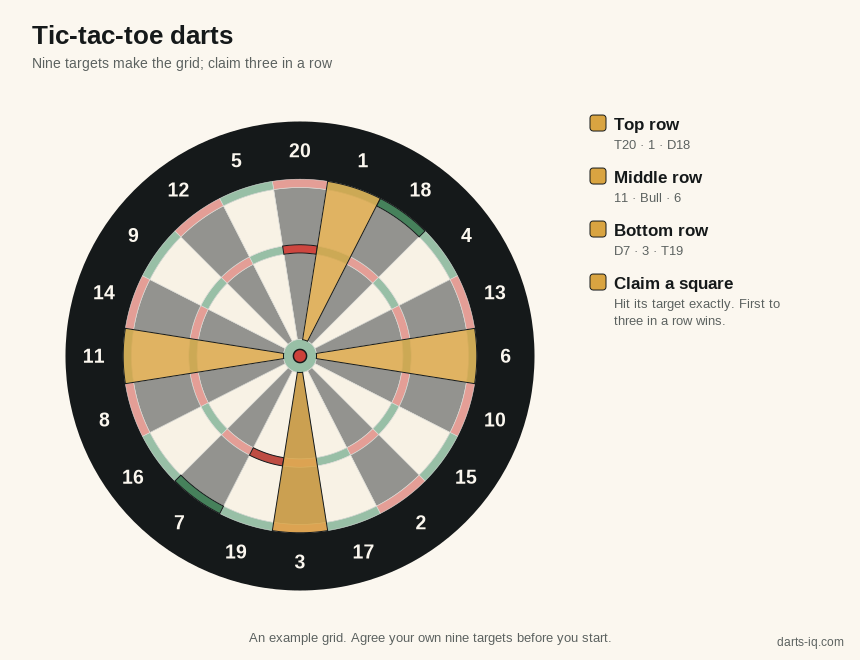
Tic-tac-toe darts at a glance
| Quick facts | |
|---|---|
| Players | 2 players or 2 teams |
| Darts per turn | 3 |
| Targets | 9 agreed targets, with the bull in the center |
| How you win | First to claim three squares in a row |
| Time to play | About 5–15 minutes a game |
How to play
- Draw the grid on a chalkboard or whiteboard: three rows of three squares.
- Write a target in each square. Put the bull in the middle. Fill the other eight with targets spread around the board, such as T20, D18, 11 or 3. Use different numbers so each square is clear.
- Pick X and O. Each side throws one dart at the bull; closest goes first.
- Take turns throwing three darts. A dart that hits an open square’s target claims it. Cross out the target and write your X or O.
- You can claim more than one square in a turn if different darts hit different open targets.
- Once a square is taken, it’s taken. Your opponent can’t steal it, and hitting it again does nothing.
- Three in a row wins: across, down or diagonally. The game ends the moment the line is made.
Rules vary. Some groups need three marks on a number to claim it (see Variations), so settle that before the first throw.
Scoring
There are no points in the basic game. You either claim a square or you don’t.
- Exact target only. If the square says T9, a single 9 or double 9 doesn’t count.
- Single squares usually mean any single of that number (both the big and small single). Some grids get picky with “small 14”, meaning only the inner single between the triple ring and the bull.
- The bull square: agree whether the outer bull (25) counts or only the inner bull (50). Counting both makes the center easier to win.
- Misses, wrong numbers and claimed squares have no effect.
Here’s a short game using this grid:
| T20 | 1 | D18 |
| 11 | Bull | 6 |
| D7 | 3 | T19 |
| Turn | Player | Darts | Result | Squares held |
|---|---|---|---|---|
| 1 | X | T20, 5, 1 | Claims T20 and 1 | X: 2 |
| 1 | O | 18, D18, 5 | Claims D18, blocking the top row | O: 1 |
| 2 | X | 20, 25, 6 | Single 20 doesn’t count (that square needs T20); outer bull claims the center; 6 claims the middle-right square | X: 4 |
| 2 | O | 11, 3, 7 | Claims 11 and 3, blocking the middle row and column; the single 7 misses D7 | O: 3 |
| 3 | X | 19, T19 | The single 19 doesn’t count; T19 completes the diagonal T20, Bull, T19 | X wins |
This group counts both bulls for the center square. Notice X’s second turn: claiming the bull and the 6 created three threats at once (the middle row, the middle column and a diagonal). O could block two of them, but not all three.
How to win (and ties)
The first side to complete a line of three wins. If all nine squares are taken with no line, it’s a draw. Most people just play again, or play best of three or five games.
In the cricket-style version (below), the game can also stall when no line is possible for either side. Call it a draw and start a new grid.
Tips and strategy
- Take the center early. The bull square is part of four lines, more than any other.
- Corners are next best. Each corner is in three lines.
- Block before you build. If your opponent has two in a line, your first dart should go at the square that stops it.
- Set up multiple threats. Two threats put pressure on your opponent, but they can block both with separate darts. Three distinct winning squares force them to hit all three targets to stop you.
- Use all three darts. If dart one claims a square, think about the next best target before you throw again.
- Build the grid for practice. Put the doubles you need for 301 or 501 into the grid.
Variations
Tic-tac-toe darts is a house game, so these versions are all common:
- Cricket-style (three marks): each square is a plain number. A single is one mark, a double two and a triple three. Three marks on a number claims the square. One version uses 12, 20, 18, 11, bull, 6, 7, 3 and 2. Track each side’s marks separately; the first side to reach three marks claims that square permanently. For the bull, count the outer bull as one mark and the inner bull as two.
- Doubles or triples: use doubles or triples in all eight outer squares, keeping the agreed bull target in the center.
- Handicap: give the stronger player doubles or triples and the newer player plain singles of the same numbers.
- Easy mode: use big singles in all eight outer squares. Good for kids.
- Teams: two teams alternate throwers; each throw claims for the team.
If you like target games, try around the clock or Shanghai. New to darts? Start with how to play darts.
FAQ
How do you play tic-tac-toe with darts?
Draw a 3x3 grid and write a dart target in each square, with the bull in the middle. Hit a square's target to put your X or O in it. The first player to get three in a row wins.
What numbers do you use for tic-tac-toe darts?
Any nine targets you agree on. The center is almost always the bull, and the other eight are a mix of singles, doubles and triples spread around the board.
Do you have to hit a number three times in tic-tac-toe darts?
In some versions, yes. One popular version works like cricket: you need three marks on a number (a single is one, a double two, a triple three) to claim its square. Others claim a square with one dart in the exact target.
Can tic-tac-toe darts end in a draw?
Yes, if all nine squares are claimed with no line of three.
Is noughts and crosses darts the same as tic-tac-toe darts?
Yes. Noughts and crosses is the British name, and some people call it OXO. The rules are the same.