
Part of our guide to 40+ dart games to play on a dart board.
Bermuda Triangle is a scoring game with one target per round, starting at 12 and finishing on the bull. Hit the target and you add the points; miss it with all three darts and your whole score is halved. It’s quick to learn and a nice change from cricket when you want to practice the less popular numbers. For other ideas, see our full list of more dart games.
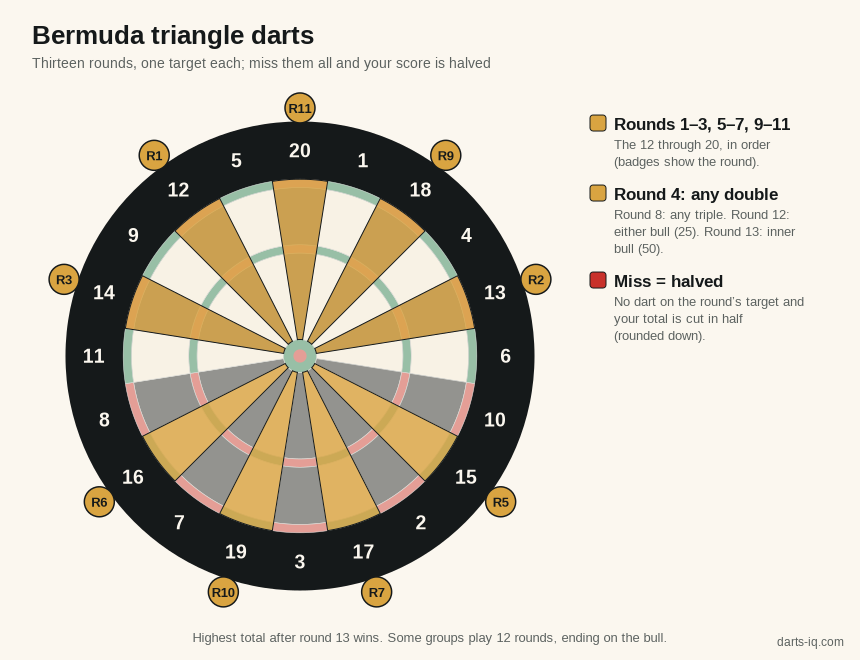
Bermuda Triangle at a glance
| Quick facts | |
|---|---|
| Players | 2 or more (also works solo) |
| Darts per turn | 3 |
| Targets | 12, 13, 14, any double, 15, 16, 17, any triple, 18, 19, 20, bull, inner bull |
| How you win | Highest total after the last round |
| Time to play | About 15–25 minutes for two players |
How to play
- Everyone starts on 0. Throw one dart each at the bull; closest goes first.
- Write the targets down the left of a board and a column for each player.
- Round 1 target is 12. Each player throws three darts. Only darts in the 12 (single, double or triple) count.
- Add the points to your running total.
- If all three darts miss the target, halve your total. That’s the penalty, and it’s what makes the game tense.
- Move to the next target and repeat: 13, 14, then any double, 15, 16, 17, any triple, 18, 19, 20, the bull (outer or inner), and finally the inner bull only.
- After the last round, the highest total wins.
Rules vary from group to group, so agree on the target list and how to round odd numbers before you start.
Scoring
- A single scores the number, a double twice the number and a triple three times. A triple 17 in the 17 round is 51.
- In the any double round, each double you hit counts at full value. D20 plus D16 is 72.
- In the any triple round, the same goes for triples. T20 alone is 60.
- In the bull round (round 12), either bull counts and each scores 25. In the final inner bull round, only the 50 counts. Twelve-round versions end on a single bull round where the outer is 25 and the inner 50.
- Missed darts score nothing, even if they land in a big number.
- Halving: a turn with no hits on the target halves your running total. Most players round down (63 becomes 31). A score of 0 stays at 0.
Here’s an example over the first five rounds, rounding down:
| Round (target) | Player A darts | Player A total | Player B darts | Player B total |
|---|---|---|---|---|
| 1 (12) | 12, 12, miss | 24 | T12, miss, miss | 36 |
| 2 (13) | T13, miss, miss | 63 | No hits: halved | 18 |
| 3 (14) | No hits: halved | 31 | 14, 14, miss | 46 |
| 4 (any double) | D20, miss, miss | 71 | D16, D8, miss | 94 |
| 5 (15) | 15, miss, miss | 86 | No hits: halved | 47 |
Notice how one miss turned Player B’s 23-point lead into a 39-point deficit. Big totals are never safe.
How to win (and ties)
The player with the highest total after the last round wins. There’s no checkout and no need to finish on a double.
If two players tie, an optional house rule is one extra round on the bull, highest score wins. Some groups just call it a shared win. Agree before you start.
Tips and strategy
- Get one dart on the target first. Once one dart has hit, the halving can’t happen, so you can take more risk with the other two.
- Aim for the big single if you’re struggling. It’s the largest area. Go for triples when you’re a confident thrower.
- Avoid the double ring on number rounds. A triple is worth more and sits inside the board, so a miss usually still lands in the number.
- In the any-triple round, pick the one you hit best. T20 is worth the most, but T19 or T18 might be safer for you.
- In the any-double round, aim at a double you’re comfortable with. D16 and D20 are popular. A miss outward scores nothing, but costs no more than any other miss.
- Protect a lead late. In the bull round, a single outer bull is all you need to avoid the halving.
Variations
Bermuda Triangle has no official rule book, so you’ll see different versions:
- 12 rounds: omit the final inner-bull-only round and end on the bull, agreeing that the outer scores 25 and the inner 50.
- Different order: some groups start at 15 or put the double and triple rounds in other places. The principle is the same.
- Rounding up: some round odd totals up instead of down when halving.
- Starting score: a few groups start everyone on 40 or so, which makes the first-round penalty matter.
- Easier version for kids: count the numbers either side of the target too.
The game is closely related to Halve-It, where you choose your own targets. If you like one-target-per-round games, try Shanghai or around the clock. New to the board? Start with how to play darts.
FAQ
How do you play Bermuda Triangle darts?
Each round has one target: 12, 13, 14, any double, 15, 16, 17, any triple, 18, 19, 20, the bull (outer or inner), then the inner bull. Hits on the target add to your score. Miss it with all three darts and your total is cut in half.
What happens if you miss in Bermuda Triangle?
If none of your three darts hits that round's target, your whole running total is halved. Most groups round odd totals down.
Is Bermuda Triangle the same as Halve-It?
They're close cousins and some people use the names for the same game. Bermuda Triangle usually means the fixed 12-to-bull sequence, while Halve-It uses a list the group agrees on.
How many rounds are in Bermuda Triangle darts?
Thirteen in the standard version: nine numbers, any double, any triple, the bull, and a final round on the inner bull only. Some groups play 12, ending on the bull.
Do doubles and triples count in Bermuda Triangle?
Yes. A triple of the target number scores three times its value and a double scores twice. In the any-double and any-triple rounds, every double or triple you hit counts at its full value.