
Part of our guide to How to play cricket darts.
Darts has its own language, much of it born in British pubs and carried onto TV. This glossary covers more than 100 words and phrases you’ll hear at the board, in a league and on the broadcast. Terms marked (UK) are mostly British. For how scoring works, start with how to play darts; for the most popular bar game, see cricket rules.
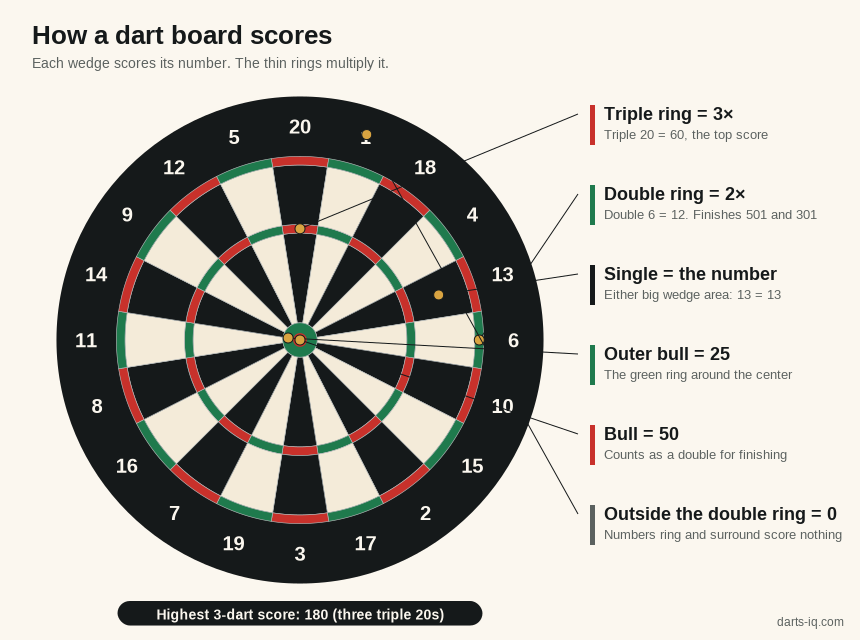
The terms you’ll hear most
| Term | Means |
|---|---|
| Ton 80 / maximum | 180, the best possible turn: three triple 20s. Also called a perfect score |
| Ton | A score of 100. “Ton-plus” or “ton 40” (140) for more |
| Double top / tops | Double 20, the finishing double at the top of the board |
| Bust | Scoring more than you need, leaving 1, or reaching zero without a double. The turn doesn’t count. Also “too hot” (UK) |
| Checkout / out / finish | The darts that take you to exactly zero. See the out chart |
| Oche | The throw line, rhymes with “hockey.” Also “toe line.” See how to mark a throw line |
| Leg / set | A leg is one game of 501 or 301; a set is a group of legs (best of five at the World Championship) |
| Game on / game shot | The caller’s start-of-leg call, and the call when the winning double lands |
Scores with nicknames
| Term | Means |
|---|---|
| Bed and breakfast | 26: usually single 20, 5 and 1. Also “breakfast,” “chips” or “two and six,” after an old price for a night’s B&B (UK) |
| Champagne breakfast | Triple 20, triple 5 and triple 1 (78): a deluxe bed and breakfast (UK) |
| Bag of nuts | 45 (UK) |
| Bag of nails / bucket of nails | Three single 1s: a score of 3 (UK) |
| Baby ton | 95, often triple 19 plus two single 19s (UK) |
| Low ton / high ton | 100–150 / 151–180 in one turn (the soft tip award definitions) |
| Lipstick | Triple 20, the red bed at the top of the board (UK) |
| Devil | Triple 6 (666), often hit by mistake aiming at the 10 or 13 |
| Annie’s room | Double 1, the last place you want to be (UK; some use it for the 1 itself) |
| Madhouse | Being left on, or finishing on, double 1 |
| Route 66 | 66 in one turn |
| Trombones | 76, after the song “76 Trombones” |
| Garden gates / two fat ladies | 88, borrowed from bingo calls (UK) |
| Dinky-doo | 22 (UK) |
| Fish, chips and peas | 33 (UK) |
| Varieties | 57, after Heinz’s “57 varieties” (UK) |
| Not old | 37 (UK) |
| Nail | A single 1 (UK) |
| Circle it | A jeer for a turn worth less than 10, which the scorer may ring on the board (UK) |
| Shanghai | A single, double and triple of the same number in one turn. The 120 finish (20, triple 20, double 20) is also called a Shanghai |
Checkouts and finishing
| Term | Means |
|---|---|
| Big fish / maximum checkout | 170, the highest finish: triple 20, triple 20, bull |
| Little fish | A nickname for a 130 checkout |
| Bogey number | A score you can’t finish in three darts: 169, 168, 166, 165, 163, 162, 159 (more in darts numbers and facts) |
| Combination finish | A checkout that needs two or three darts at different targets, not one double |
| Bull-out / bull finish | Winning a leg by finishing on the bull |
| Motown | 44 checked out as single 4, double 20 |
| Double trouble | Struggling to hit the double you need to win |
| Hail Mary / bail-out | A big last dart that rescues a turn after two bad ones |
| Champagne finish | A big, high-pressure checkout, often on the bull |
| Double in / double out | You must hit a double to start / to finish. See 301 rules |
| Straight in / straight out | Any dart starts scoring / any dart can finish (no double needed). Also “single in/out” |
| Master out | A finish rule where the last dart can be a double, a triple or the bull |
| Nine-darter / perfect game | Finishing a 501 leg in the minimum nine darts. See the nine-dart finish |
The board and the dart
| Term | Means |
|---|---|
| Bull / bullseye | The inner bull, worth 50; it counts as a double. Also “cork” or “black hat” on boards with a black center |
| Outer bull | The green ring around the bull, worth 25. Also “single bull” |
| Double / triple ring | The thin outer and inner rings, worth 2× and 3× |
| Treble | The British word for a triple: “treble 20” is the triple 20 |
| Bed | A scoring area of one number, such as the triple 20 bed |
| Fat / little | The big single area of a number (between triple and double rings) / the thin single between the bull and the triple ring |
| Island | The scoring area inside the double ring. A dart outside it is “off the island” (UK) |
| Upstairs / downstairs | The top of the board around the 20 / the bottom, around the 19 (where you switch when the 20 is blocked) |
| Spider / web | The whole wire frame that divides the segments |
| Wire | One of the metal dividers. “Wired it” means a dart just missed by hitting the wire |
| Clock | Slang for the board itself, as in “round the clock” |
| Arrows | The darts. “Good arrows!” is praise for a good turn (UK) |
| Barrel | The weighted metal body of the dart you grip, usually tungsten or brass |
| Shaft / stem | The piece between the barrel and the flight |
| Flights / feathers | The fins at the back that steady the dart |
| Point / tip | The steel or plastic end that goes into the board |
| Bombs / bombers | Big, heavy darts, traditionally brass (UK) |
Throwing and the turn
| Term | Means |
|---|---|
| Visit / throw / turn | One turn of three darts |
| Grouping | Darts landing close together. “Nice group” is a compliment |
| Stacker / under stacker | A dart that lands touching one already in the board / just below and touching it |
| Robin Hood | A dart that sticks into the shaft or back of another dart (does it count?) |
| Bounce-out / fallout | A dart that hits and doesn’t stick |
| Slop / splash | Darts that score, but not where you aimed |
| Buckshot | Three darts scattered all over the board |
| Woody | A dart that misses the scoring area completely (UK) |
| Splitting the 11 | A dart that lands between the two 1s of the “11” on the number ring |
| Wet feet / paddling | Having a foot over the oche while throwing (UK) |
| Bull up / diddle for the middle | One dart each at the bull to decide who throws first |
| Striking oil | Hitting the inner bull when bulling up for first throw |
| Mugs away | House rule: the loser of the last game throws first in the next (UK) |
Games and matches
| Term | Means |
|---|---|
| Leg shot | The call when a leg is won |
| Break of throw / hold of throw | Winning a leg your opponent threw first in / winning one you threw first in |
| Shut out | Losing a game without scoring (UK slang: “granny”) |
| Chalker | The person keeping score |
| Round the clock | A game of hitting 1 through 20 in order, often finishing on the bull |
| Killer | Each player gets a number and lives, then knocks the others out. See how to play darts |
| Set | A group of legs; best of five at the World Championship and World Grand Prix. See how to watch darts in the US |
Cricket and soft tip awards
Electronic boards flash these in cricket and other games:
| Term | Means |
|---|---|
| Hat trick | Three bulls in one turn |
| Three in the black | Three double bulls |
| Three in a bed | Three darts in the same triple (or double) |
| White horse | Three different cricket triples in one turn. Some boards, including Arachnid Galaxy models, require all three numbers to have no previous marks by you. |
| Round of terms | Three triples in one cricket turn (house definitions vary) |
| Ton 80 | 180 in an 01 game |
| High ton / low ton | 151–180 / 100–150 in one turn |
| MPR / PPD | League stats: marks per round and points per dart. See darts stats |
People and culture
| Term | Means |
|---|---|
| Shooter | An American word for a darts player |
| Archer | A player with a smooth, quick throw (UK) |
| Chucker | Someone who throws hard without really aiming |
| Dartitis | A mental block that stops a player releasing the dart cleanly, like the “yips” in golf. See our dartitis guide |
Playing with three or more? Cut-throat cricket is where the trash talk really starts.
For the game’s origins and basics, see what is darts?
FAQ
What does ton 80 mean in darts?
A score of 180, the maximum with three darts: all three in the triple 20. A 'ton' is 100, so 'ton 80' is 180.
What is a white horse in darts?
In cricket, three different triples on cricket numbers in one turn, such as triple 20, triple 19 and triple 18. Some boards, including Arachnid Galaxy models, require all three numbers to have no previous marks by you. Electronic boards play an animation for it.
Why is 26 called bed and breakfast in darts?
A score of 26, usually a 20, a 5 and a 1. It's an old British nickname: a night's bed and breakfast once cost 'two and six' (2 shillings and sixpence).
What is a hat trick in darts?
Three bulls in one turn. On electronic boards, three double bulls is called 'three in the black.'
What is madhouse in darts?
Being left on double 1 (a score of 2), the finish everyone dreads.
What is a leg and a set in darts?
A leg is one game of 501 (or 301). A set is a group of legs, usually best of five. Most matches are played in legs; the World Championship uses sets.
What is a big fish in darts?
A 170 checkout, the highest possible finish: triple 20, triple 20, bull. It's the most celebrated finish in the game.
What is a lipstick in darts?
Triple 20, the red triple bed at the top of the board. It's British pub slang; 'in the lipstick' means a dart in triple 20.
What is three in a bed in darts?
All three darts in the same triple (or double) in one turn. Three in the triple 20 bed is a 180.
What is a Robin Hood in darts?
A dart that sticks into the back or shaft of a dart already in the board, named after the archer who split his rival's arrow.
What do Brits call darts?
The game is just 'darts', but players call the darts themselves 'arrows'. 'Good arrows!' is praise for a good turn.
What is a person who plays darts called?
A darts player (in the UK) or a dart player (in the US). American league players also say 'darter'. 'Dart thrower' is used too.
What do you call a girl who is good at darts?
There's no special word: she's a darts player. Women play on the PDC Women's Series and the WDF circuit, and the top women earn places in the PDC World Championship.
What is dartitis?
A mental block that stops a player releasing the dart cleanly, like the 'yips' in golf. The player freezes or jerks at the point of release. Five-time world champion Eric Bristow famously suffered from it.