
Part of our guide to 40+ dart games to play on a dart board.
501 in one line: everyone starts on 501, takes turns throwing three darts, and the first to hit exactly zero with a double wins. It’s the standard game in steel tip leagues and most professional steel tip tournaments, and, with cricket, one of the two games every player should know. Once you know it, try more dart games.
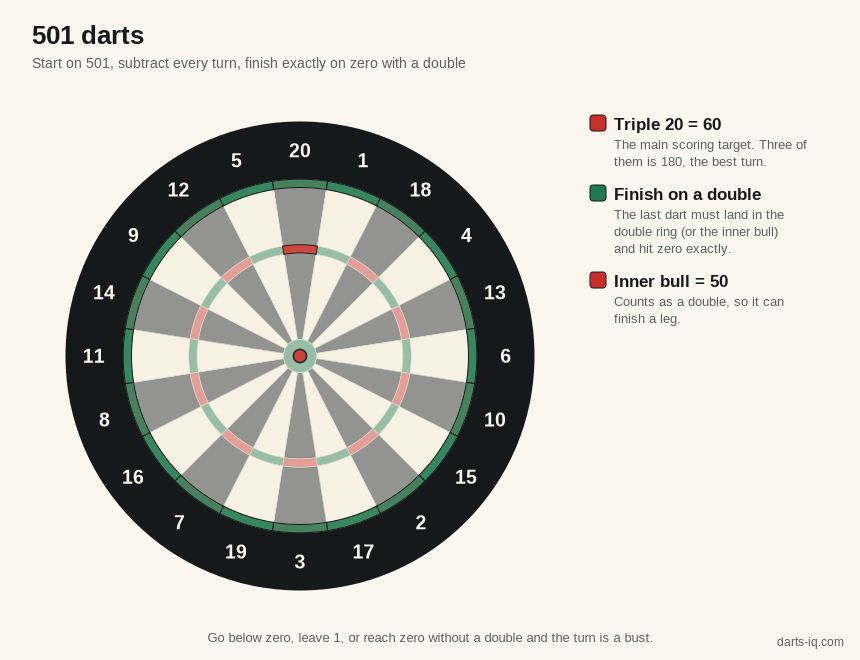
501 at a glance
| Quick facts | |
|---|---|
| Players | 2 or more, or teams (doubles) |
| Darts per turn | 3 |
| Targets | Anything that scores; you finish on a double |
| How you win | Reach exactly zero, last dart in a double or the inner bull |
| Time to play | 5 to 15 minutes a leg for casual players |
How to play
- Decide who throws first. Most players throw one dart each at the bull; closest goes first.
- Each player starts on 501.
- On your turn, throw three darts and add up the score. The highest possible turn is 180 (three triple 20s).
- Subtract that total from your score and write the new number down.
- Keep going in turns until you can finish. Your last dart must land in a double (or the inner bull, which counts as double 25) and bring you to exactly zero.
- If you bust, your score goes back to what it was before that turn.
- First to zero wins the leg.
Unlike US bar 301, standard 501 has no double in. Every dart counts from the first throw.
Scoring
Score the darts as normal: the number, double ring 2×, triple ring 3×, outer bull 25, inner bull 50. Subtract each turn from what you have left.
Busts. A turn is a bust if it would take you below zero, leave you on 1 (you can’t finish 1 with a double), or reach zero without a double. Once you bust, the turn ends and the darts you’ve thrown that turn don’t count. (Darts that fall out, land on the wire or stick in another dart: see darts scoring rulings.)
Example scoresheet:
| Turn | Ann scores | Ann left | Ben scores | Ben left |
|---|---|---|---|---|
| Start | 501 | 501 | ||
| 1 | 100 | 401 | 60 | 441 |
| 2 | 140 | 261 | 81 | 360 |
| 3 | 85 | 176 | 125 | 235 |
| 4 | 100 | 76 | 180 | 55 |
| 5 | Bust | 76 | 55 | 0 |
On turn 5 Ann hits triple 20 (16 left), then a single 16. That’s zero, but not on a double, so it’s a bust and she stays on 76. Ben, on 55, hits single 15 then double 20. He wins the leg.
Checkout basics. Any score of 170 or less might be finishable in one turn, but not all of them are. 169, 168, 166, 165, 163, 162 and 159 can’t be done in three darts. The checkout calculator gives the best route for any score.
How to win (and ties)
A leg is one game of 501. Matches are usually played over several legs:
- Legs: first to win a set number, such as best of three or best of five.
- Sets: in set play, a set is usually best of five legs, and the match is best of a number of sets.
The throw usually alternates each leg, because throwing first is an advantage. There are no ties in 501: someone always checks out first.
The nine-dart finish is the perfect leg: 501 in the fewest darts possible. The classic route is 180, 180, then 141 (triple 20, triple 19, double 12). It’s rare even for pros.
Tips and strategy
- Aim at triple 20 for scoring. If you keep drifting into the 1 and 5, many players switch to triple 19, where the misses (7 and 3) cost less.
- Plan your finish from about 170 down. Think about what you’ll leave, not just what you’ll score.
- Leave a friendly double. 32 (double 16) is the favorite: miss into the single 16 and you’re on 16 (double 8), then 8 (double 4).
- Avoid odd numbers when you’re close. When possible, leave an even number from 2 through 40 so you can finish on a double with one dart.
- Steer clear of bogey numbers. On 229, a 60 leaves 169, which you can’t finish in three darts (the full list is in darts numbers and facts); aim to leave something like 170 or less that isn’t a bogey.
- Count before you throw. Check your remaining score before each dart to avoid an unnecessary bust.
Variations
Rules vary, so agree before the first dart:
- Straight out: any dart that reaches exactly zero wins. Easier for beginners and kids.
- Double in, double out: you need a double to start scoring, as in many US 301 games.
- Master out: some soft tip boards let you finish on a double or a triple.
- Fat bull: on many electronic boards the whole bull can count as 50. Check the settings before a league match.
Want a shorter game? Try 301. New to the board? Start with how to play darts, or try cricket for a change of pace.
Keeping score by hand gets old fast: our guide to dart scoreboards compares chalkboards, apps and camera auto-scoring.
FAQ
What are the rules of 501 darts?
Each player starts on 501 and subtracts what they score with three darts each turn. The first to reach exactly zero, with the last dart in a double or the inner bull, wins the leg.
Do you have to finish on a double in 501?
Yes, in standard 501 the last dart must land in the double ring or the inner bull (which counts as double 25). Some casual steel tip games use straight out, where any scoring dart that brings the total to exactly zero wins. Open-in/open-out is also an official format in some soft tip competitions.
What is a bust in 501?
A turn that takes you below zero, leaves you on 1, or reaches zero without a double. The whole turn is canceled and your score goes back to what it was before that turn.
What happens if you have 1 left in 501?
It's a bust. You can't finish 1 with a double, so any turn that leaves 1 is canceled and your score goes back to what it was at the start of that turn.
Does a dart that falls out of the board count?
On a steel tip board, no: a dart has to stay in the board until you pull it out, so a bounce-out or a dart that drops scores nothing. On a soft tip machine, a dart that registers usually counts even if it falls out.
What do T and D mean on a darts scoreboard?
T is a triple and D is a double: T20 is triple 20 (60 points) and D16 is double 16 (32). On many scoreboards 'DB' (double bull) is the inner bull, 50, and 'SB' or '25' is the outer bull.
Do you need a double to start 501?
No. Standard 501 is straight in, double out: any dart starts your scoring. Starting on a double ('double in') is the usual rule in 301, and some leagues play 501 that way too.
What is a nine-dart finish?
Winning a 501 leg with the fewest darts possible: nine. A classic route is 180 (three triple 20s), 180 again, then triple 20, triple 19, double 12 for 141.
What is the highest checkout in 501?
170: triple 20, triple 20, inner bull. Every other checkout ends on a double too, since the bull counts as one; several scores from 159 to 169 can't be finished in three darts.
How many legs are in a set of darts?
In pro set play a set is usually best of five legs, so first to three. Leagues and pub matches often just play a single leg or best of three legs.
Do you have to throw all three darts in 501?
No. You can stop once you've checked out, and players sometimes hold a dart back rather than risk a bust. Any dart you don't throw scores nothing.
Why is darts 501 and not 500?
Nobody wrote down why, but the usual explanation is that an odd start makes the finish harder. Every double is even, so from an odd number you can't reach zero with doubles alone; you have to hit an odd score along the way. Old games were played from 301 and 1001 too, all odd.
What is a 3-dart average in 501?
Your total points divided by darts thrown, times three. Finishing 501 in 15 darts is a 100.2 average; in 30 darts it's 50.1. See our guide to darts stats for what counts as a good number.